
TheNewspaper.com


top headlines:

Sunday, November 15, 2009
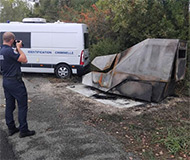
Dorset, UK Speed Camera Destroyed by Fire
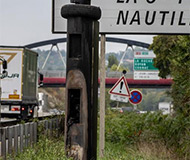
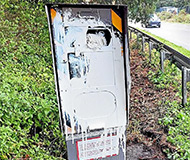
Mayor Queenie ComfortVigilantes set fire to a speed camera in Dorset, UK at around 2am on Thursday. The automated ticketing machine had been operating in the Longham area of Ringwood Road until a burning tire put the device out of commission. This is the fourth attack in the area since August when vigilantes also eliminated cameras on Magna Road in Bearwood, Ringwood Road in Verwood and Horton Road in Three Legged Cross. Cameras were also destroyed in 2006. "The cameras also cost a lot," Ferndown Mayor Queenie Comfort told the Bournemouth Echo newspaper. "When you set tires on fire they make a most ghastly smell and they are toxic."
Source: Longham speed camera torched by vandals (Bournemouth Echo (UK), 11/13/2009)


Saturday, November 14, 2009
European Union Creates International Speeding Ticket
Eucaris mapSpeeding tickets are beginning to cross international borders in Europe, thanks to the European car and driving license information system, or Eucaris. At the beginning of the year, Swiss motorists began being charged for speed camera tickets issued by French authorities. As of October, the French government had collected on a total of 10,000 citations from violations allegedly committed by vehicles registered in Switzerland. A total of 1800 tickets were issued last month alone. Prior to Eucaris, most countries had no means of collecting on automated tickets issued to non-citizens because there was no automated system that could identify vehicle registrations in a foreign country. Beginning in 1994, a number of authorities upset by losing millions in potential revenue created the drive to standardize the sharing of electronic vehicle and driver's license records among the disparate database systems in twenty countries. Progress in connecting these databases has been slow. Only last year did The Netherlands and Germany become the first to swap speed camera ticketing information through the Eucaris system. Cross-border tickets will also be issued in Belgium as part of a bilateral information exchange program. Belgium, Estonia, Germany, Hungary, Iceland, Ireland, Latvia, Lithuania, Luxembourg, Romania, Slovakia, Sweden, Switzerland, The Netherlands and the United Kingdom have all signed the Eucaris treaty with the rest of the European Union countries expected on board by August 2011. Once fully connected, officials hope to be able to issue fully international speeding tickets and introduce further uses, such as the collection of per-mile taxes.


Friday, November 13, 2009
Second Texas City Initiates Traffic Camera Referendum
Baytown speed limit signInspired by the success of the College Station, Texas initiative banning red light cameras, activists a hundred miles away in are collecting signatures to do the same in Baytown. Officials in the Gulf Coast city of 72,000 allowed American Traffic Solutions to set up the cameras in April 2008, but resident Byron Schirmbeck is circulating a petition in the hopes of giving voters the opportunity to take them back down. "The response has been absolutely overwhelming," Schirmbeck told TheNewspaper. "I am conservative in saying that I have had less than ten percent of people I asked at public places refuse to sign because they support the cameras. The usual response to the question, 'Would you like to sign the petition to ban the red light cameras?' is 'Hell yes' and 'Can I get my wife to sign it too?'" Schirmbeck formed the Baytown Red Light Camera Coalition PAC to coordinate the petition drive. He needs 620 verified signatures to qualify the initiative for the next ballot. No photo enforcement program has ever survived a public referendum. Schirmbeck has been especially interested in the issue since he caught the city using illegally short yellow times in an effort to increase revenue. After he beat his ticket at West Baker and Garth Roads earlier this year, the city increased the yellow time to 4.5 seconds on June 5. Seeing the number of $75 violations drop, the city decreased the yellow time to 4.0 seconds in July. The city justified this change by putting up a 40 MPH speed limit sign on the camera-monitored approach, even though the other side of the same road is posted at 45 MPH. Texas law sets minimum yellow timing standards according to the posted speed limit. "Just when I think I have seen the city do everything they can to keep their revenue with the cameras they go and surprise me again," Schirmbeck said.


Thursday, November 12, 2009
Texas: Red Light Camera Company Blocks Referendum
Jim Ash on November 3A lawsuit funded by a photo enforcement company succeeded yesterday in temporarily blocking the results of the vote to end red light cameras in College Station, Texas. Judge Suzanne Stovall granted a temporary restraining order preventing the city from ending its contract with American Traffic Solutions, despite the November 3 vote of a majority of residents demanding that the cameras come down. The law firm of Bovey, Akers and Bojorquez ostensibly filed the lawsuit on behalf of the Keep College Station Safe Political Action Committee (PAC), a group entirely funded by College Station's camera vendor, American Traffic Solutions (ATS) and its subcontractors. Of the PAC's $67,100 in reported funding, the largest chunk -- $30,000 -- came directly from ATS. Garry Mauro, a paid ATS consultant, gave $5000. Another $8000 came from Signal Electric, a Washington-based contractor that installs red light cameras for ATS. ForceCon Services, a Texas-based red light camera installation subcontractor, gave $5000. Questmark Information Management Inc, a company that prints citations for ATS, provided a $16,600 in-kind donation. The company's election challenge argued that the initiative petition was invalid because it referenced an ordinance "enacted 10/25/08" when the ordinance in question had actually passed in October 2007. "Given the failure on the part of the 'initiative petitions' to identify with reasonable specificity the ordinance sought to be repealed, as identified by its date of adoption, the court cannot ascertain the true outcome of the election and the election should be declared void," the ATS-backed suit explained. The suit also contended that the initiative was actually a "referendum" that should have been filed in 2007, twenty days after the ordinance was adopted. Against this, Ash argued that his petition to the city council, signed by residents, was labeled "initiative" not "referendum." Moreover, the petition declares the "powers" referenced by the ordinance to be "deemed and declared unenforceable" -- a legislative action that would do more than simply overturn a particular ordinance. Although College Station officials are named as defendants in the lawsuit, the city had been planning for this action. The city also admitted that it did not believe there was any mandate to take down the red light cameras, despite the election results. "College Station was concerned that the petition was invalid because it was a referendum that was untimely filed, and told [petition sponsor Jim Ash] that regardless the city would submit the petition to the voters, but that the petition may be challenged in court," the city's brief to the court explained. "Such results do not in themselves send a clear message to College Station that the electorate overwhelmingly desires that red light cameras be banned." Hearings on the issue will continue on November 20.


Wednesday, November 11, 2009
Rhode Island Governor Vetoes E-ZPass Privacy Bill
Governor Donald CarcieriRhode Island Governor Donald Carcieri (R) on Monday vetoed legislation that would have imposed privacy restrictions on the use of E-ZPass toll transponder data. The scuttled bill also included a ban on schools and government agencies from using the same Radio Frequency Identification (RFID) transponder chips to track schoolchildren. Carcieri focused on the positive aspects of tracking children in his veto message. "Why would the General Assembly therefore place restrictions on the use of this technology as an option for all students?" Carcieri wrote. "In certain circumstances, it may be helpful for schools to have the ability to quickly identify where each of their students is located... Such circumstances may include weather-related natural disasters, terrorist or criminal events or even a need for use during field trips and outside school activities." This is the third time that Carcieri has vetoed a version of RFID privacy legislation. In 2006, lawmakers passed a bill that would have prohibited state and local government from using RFID to track their employees and schoolchildren in addition to restricting the use of RFID toll transponder information. The employee protection was dropped as a compromise. "Originally developed to track cattle and commerce, RFID technology allows a person's identity and movement to be monitored electronically," the Rhode Island branch of the American Civil Liberties Union explained. "When the Middletown school district last year began a pilot program that placed RFID chips on the backpacks of elementary school children, purportedly to make sure they got on the right school bus, the need for this legislation became more apparent than ever." The motorist protection vetoed in S. 211 specified that the RFID information used in a toll road transaction could not be considered public information. It further clarified that no law enforcement agency could gather or use RFID information without a court order -- unless he was investigating someone for not paying tolls. Courts around the country are split on the question of whether warrantless use of automobile tracking devices is lawful. The high court in Massachusetts recently said no while Wisconsin's second-highest court said yes. A copy of S. 211 is available in a 10k PDF file at the source link below.
Source: PDF File S. 211 (Rhode Island General Assembly, 11/10/2009)


website features

This is a journal covering motoring issues from around the world from a political perspective.


search tips | about us | site map

Subscribe
Receive free email or RSS news updates. RSS Feed

Key Documents
Documents, studies and memos about camera enforcement.

Archives
View previous news items.

Feedback
Contact the editors.

View Main Topics:


Popular Stories

-Missouri Cop Harassment Video

-Photo Enforcement Bans

-Most Popular Stories

Popular Studies

-Red Light Camera Study Roundup

-2007 Virginia DOT: Cameras Increase Injury Accidents

-2005 Washington Post: Accidents Doubled with Cameras

-2004 North Carolina: Red Light Camera Study (Burkey-Obeng)

-Majority Leader Armey Red Light Camera Report

-Longer Yellows Reduce Crashes (TX Transportation Institute)

-HOV/Carpool Lanes Cause Accidents


Did you know?

Since 1999, Washington, D.C. cameras have issued 4,019,023 tickets worth $305 million (as of 8/31/09).
---
Previous PageNext Page

theNewspaper.com: A Journal of the Politics of Driving
Archives | Contact | Site Map | Search | Documents | Privacy Policy